… and why they’re outperforming traditional creative
For years, brands have been told that great creative wins attention. And while that’s still true, something unexpected is happening across Meta campaigns: text-only ads – the simplest possible visual format – are delivering exceptional performance across multiple industries.
But the real story isn’t in the numbers alone. It’s in what those numbers reveal about the psychology of attention, decision-making and message clarity in social environments.
Let’s break down what the data tells us.
1. Text-only ads drive fast comprehension (K’s For R U OK?) |
|
 |
The R U OK? campaign produced a healthy CTR of 1.35% and drove 365 registrations. But the important insight here is why this happened:
👉 The ad didn’t rely on imagery to explain the action. 👉 The message stated the offer immediately. 👉 Users knew exactly what they were clicking on. The ability to attract a large volume of interested people at a strong cost per acquisition shows that simplicity helps users self-select faster. There’s no confusion, no mixed signals, just a direct path to action. |
2. Low CTR doesn’t equal poor performance (WAGEC) |
|
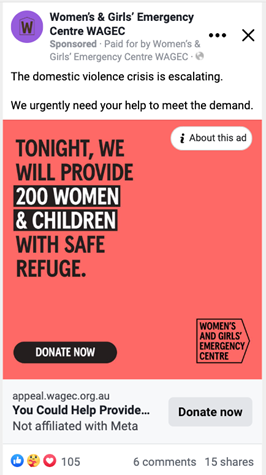 |
The WAGEC donation ad tells a different story, but one that’s equally important.
A 0.22% CTR sounds low on paper. But when the conversion rate is nearly 12%, something very interesting is happening: 👉 The ad is filtering out low-intent users and attracting people who genuinely want to donate. This is one of the overlooked advantages of text-first ads: 👉 They don’t generate empty engagement. They speak directly to people with emotional alignment, creating a clearer signal for Meta’s algorithm. Despite fewer clicks, the quality of traffic was significantly higher. This demonstrates that a simple message can carry emotional weight without visual storytelling. |
3. Strong value propositions shine without visual distraction (MSI Asia Pacific) |
|
|
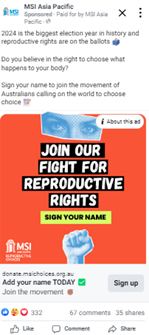
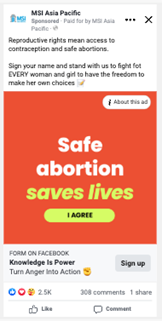
MSI’s lead gen results are the clearest indicator that text-only creative works exceptionally well when the offer is strong.
Campaign A converted at 54%. Both achieved low CPLs and significant lead volumes. What this proves is: 👉 Highly specific messaging accelerates decision-making. 👉 Users respond better when the benefit is clear in the first line. 👉 Visual simplicity forces cognitive focus onto the value proposition itself. |
Why these patterns keep emerging
When people are looking for a solution, they don’t need graphics. They need answers. Across all campaigns, text-only ads performed well for three key reasons:
- Pattern disruption: Ironically, the most “boring” ads stand out in a high-noise environment.
- Message primacy: With no visuals to lean on, the copy must be airtight. This means the audience gets exactly what they need: clarity.
- Higher-intent traffic: These ads naturally filter out casual scrollers, ensuring only the most interested users engage.
The big picture
Text-only Meta ads aren’t a creative shortcut. They’re a strategic advantage in a world overwhelmed with visuals.
If your brand hasn’t tested text-first creative yet, now is the perfect time. Not because it’s trendy, but because the data shows it works.