
Two burning questions about Donor Retention that got us fired up after our DigiRaise presentation.
Burning question 1: Why is fundraising addicted to acquisition when retention delivers the dollars?
We work in the fundraising sector where: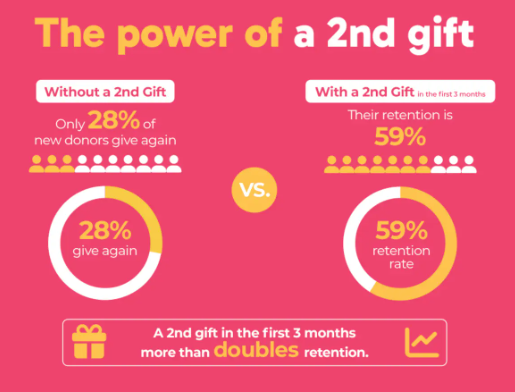
- 60% or RG income is from 5+ year donors (who are only 17% of the donor base) and
- only 28% of first time donors give again EVER!
Our sector literally wouldn’t survive without loyal donors. So why is retention always an afterthought?
Most orgs have a pretty simple, but working, donor retention journey. If you’re a donor of standard value (under $500-$1000 a year), it’s really very campaign based. 3 Appeals and 2 newsletters. For donors that give more dollars – they get a little bit more personal. It often looks like this:
| Standard value | Mid Value | High Value |
|
|
|
Retention is often a BAU afterthought – if it’s included at all. Loyal donors that give again and again are literally the lifeblood of this sector. But they’re treated as second class citizens in our strategies when we know:
- 72% of new donors won’t give again
- Only 4.48 million Aussies are charity donors
- 5% increase in retention is 25-95% increase in net profti
- A 2nd gift in the first 3 months doubles retention of a donor
Retention isn’t about keeping people, it’s about lifetime value. So why aren’t we doing it better?
Burning question 2: Why is Retention reporting so hard / not important to fundraisers?
Why is it that most charities don’t have attrition and retention reports? It’s easy to come up with a list of potential reasons:
- Under resourced or time poor?
- Don’t have a CRM or don’t have the right CRM set up or processes to update the data so they can pull reports?
- Don’t have the data skills in house?
- Their manager/ exec team/ board aren’t asking for these numbers?
- They don’t do any regular (monthly) reporting at all, let alone retention?
- They don’t realise how important it is?
The answer is probably all of the above bar one or two items which will vary for every organisation.
I suspect it’s as simple as this – they’re flat out trying to keep up with delivering their Business as Usual (BAU) fundraising campaigns and they’ve had to move onto the next urgent thing before the report could be done.
But why isn’t regular reporting for retention and attrition part of BAU?
Recently I was asked to present about Retention at the DigiRaise conference. As an agency, I have a lot of conversion data for websites and donation pages, for Lead and donor Acquisition campaigns, for appeals and P2P events. But (rightly) we don’t have access to an org’s CRM and retention data.
So I asked some of our fundraising clients if they could share some retention data with me (just aggregate numbers and trends, no personally identifiable data). I put together a written brief and data brief in excel with all the fields we’d need to do the analysis for them (Pro Bono) and give them back this data. (I admit my timing could have been better. I made this request in late March.)
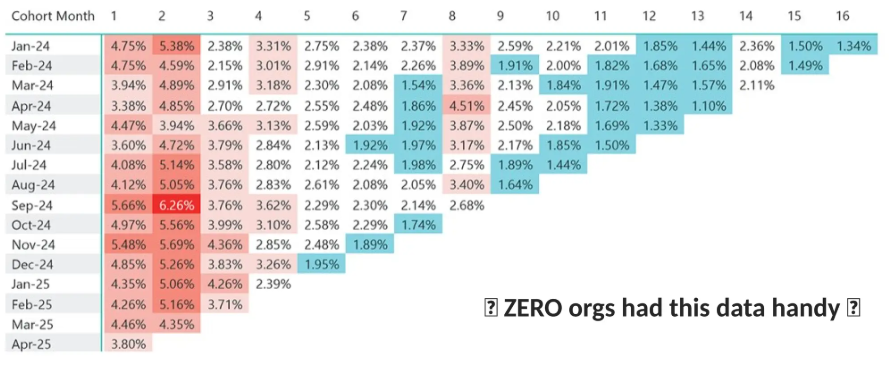
The outcome: From the client orgs, not one was able to give me any actual data. At the 11th hour, 1 org was able to give me a few anecdotal insights.
What this tells us is that NO ONE HAS RETENTION REPORTING ON HAND.
They couldn’t give me the numbers because they don’t have a high level report that’s done regularly (monthly or quarterly). Every time they get a request like mine (if they get these requests), it’s a massive piece of work to:
- Create the data brief and identify the right fields and naming conventions
- Pull the various data points from the CRM (across multiple channels and fundraising streams)
- Do the data clean up and formatting to be able to mine it
- Mine/ query the data to answer the questions in the brief (get the numbers)
- Put it into an excel report
- Analyse it for insights
- Put the insights into a useable report to recommend or inform actions.
This takes time and skills and experience. In this instance Parachute was offering to do 5 out of 7 of those steps, for free. What we generated for each org would have been a very valuable retention report template that they could continue using and updating each month. And not 1 organisation could prioritise pulling this data.
From a sector where 60% of RG income comes from 5+ year donors. And only 28% of first time donors ever giving again – we should be laser focused on attrition and retention metrics.
3. The solution: 7 ways we build retention into our donor acquisition projects.
- Target the right people to donate (40+ with giving propensity)
 Include a strict KPI into F2F contracts that 60% of RG sign ups must be 40+ years of age
- Build 2nd gift strategies and KPIs into our campaigns
- Thank donors profusely and often – you can never thank them enough!
- Design your donor journey to reduce attrition at the key drop off points – first 2 weeks, month 2, month 6 and month 12.
- Implement Conversion rate optimisation (CRO is constant testing for incremental improvements) into fundraising BAU for every campaign or appeal
- ROI reporting tracks subsequent giving after acquisition (by channel/ program).
Retention can never be an afterthought when our charity fundraising programs couldn’t survive without loyal donors who give again and again.
We’re known as a powerhouse agency for lead generation and digital donor acquisition. We also run many year-on-year P2P events and do almost two dozen appeals a year. At least 50% of our work is digital donor acquisition & lead generation. But we have 💯 bought into the retention mindset and reporting. If your organisation needs help to better understand your donor retention and what you can do to improve it – get in touch for a free chat?
Keen to learn more? Get my full presentation here.
this is great, thank you so much for focusing on this. Retention is key, especially now but it’s often dealt with in silos and other departments…